What
is colour?
Introduction
Colour is the visual perceptual property form in humans to different categories called red, blue, yellow, and others. Colour was
found from the spectrum of light interacting with our eye with the spectral
sensitivities of our light receptors. Colour
categories and physical specifications of colour are also connect with objects
or materials based on their physical properties such as light absorption,
reflection, or dispersion of spectra. By identifying a color space, colors can be found in number by their
coordinates.
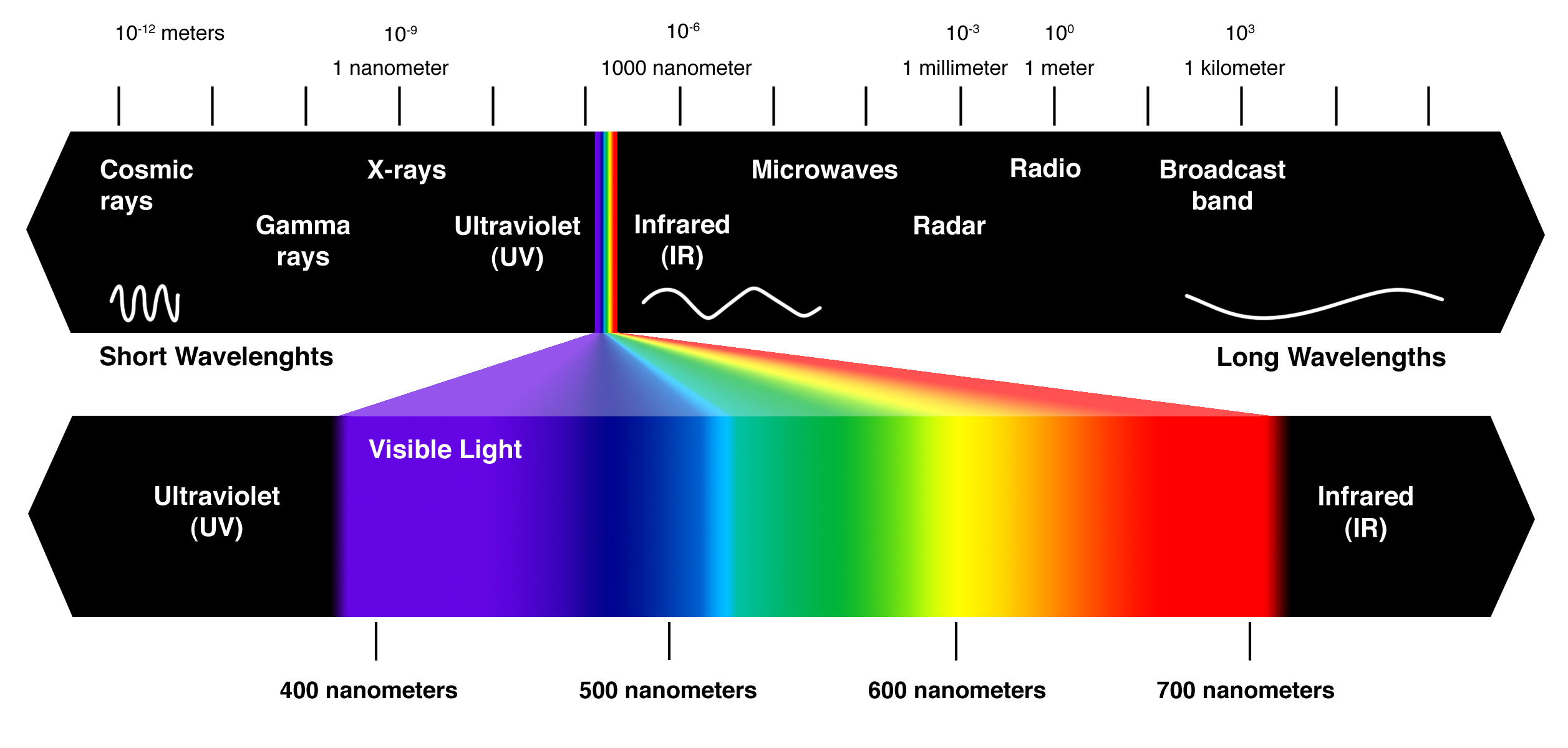 |
| Spectrum of light |
image sources:http://www.theskepticsguide.org/wp-content/uploads/2014/12/Visible-spectrum.jpeg
 |
| Light dispersion |
image sources:http://neonblog.co.uk/wp-content/uploads/2013/03/prismsmall.jpg
image sources: https://developer.apple.com/library/mac/documentation/GraphicsImaging/Conceptual/csintro/art/csl03_2x.png
image sources:http://www.tomdalling.com/images/posts/modern-opengl-06/red-reflectance.png
Because knowledge of colour stems from the
varying spectral sensitivity of different types of cone cells in
the retina to different parts of the spectrum,
colours may be interpreted and quantified by the degree to which they stimulate
these cells. These physical or physiological quantifications
of color, however, do not explain the psychophysical perception
of colour appearance completely.
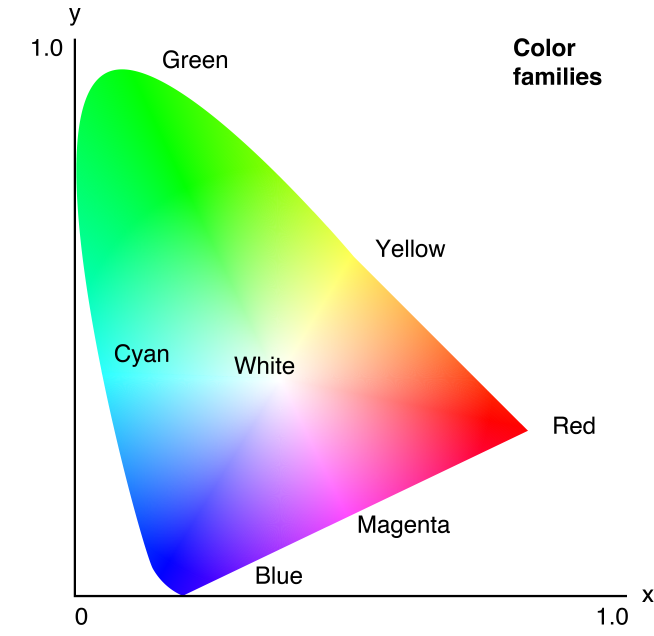 |
| Colour space |
 |
| Light absorption and reflection |
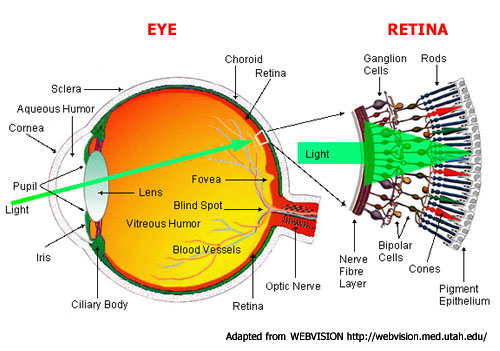 |
| Cone cell in retina
image sources:http://www.astrosurf.com/re/eye_anatomy.jpg
|
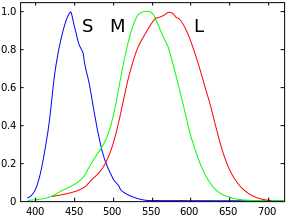 | |||
| Spectral sensitivities
image sources:http://upload.wikimedia.org/wikipedia/commons/thumb/1/1e/Cones_SMJ2_E.svg/287px-Cones_SMJ2_E.svg.png
The
science of colour
is sometimes called chromatics, colourimetry or
simply colour science. It involve the perception of colour by our human eye and brain, the origin of colour in materials, colour theory in art
and the physics of electromagnetic radiation in the visible range that commonly refer about
light

History of colour
Colour has been used for more than 30,000 years, starting with cave painting
image sources:http://www.fanningart.com/wp-content/uploads/2010/11/cave-painting.jpg
When the early Egyptians used colour that they believed it had magical abilities, often to do with healing.They worshipped the sun, knowing that without light there can be no life. They looked at nature and copied it in many aspects of their lives. The floors of their temples were often green - as the grass which then grew alongside their river, the Nile. Blue was a very important colour to the Egyptians as the colour of the sky. They built temples for healing and used gems (crystals) through which the sunlight shone. They would have a different rooms for different colours. They created the colours red, yellow and orange through developing pigment in the soil. "Blue Frit"was also created by the Egyptions over 5,000 years ago by grinding down blue grass. We could perhaps relate our present methods of colour/light therapy to this ancient practice.  There are lists on papyrus dating back to 1550 BC of colour "cures". Their deep knowledge and understanding of the healing powers of the colour rays was nearly lost when, later on in history, the Greeks considered colour was only as a science. Hippocrates, amongst others, abandoned the metaphysical side of colour, concentrating only on the scientific aspect. Fortunately, despite this, the knowledge and philosophy of colour was handed down through the ages by a few. 
Hippocrates
image sources:http://upload.wikimedia.org/wikipedia/commons/3/32/Hippocrates_rubens.jpg The Chinese also apparently practiced Colour Healing. The Nei/ching, 2000 years old, records colour diagnoses.  image sources:http://video.chaoxing.com/images/ztnew/xltm1953-1.jpg Some of the early studies and theories about light were done by Aristotle.He discovered that by mixing two colours, a third is produced. He did this with a yellow and blue piece of glass, which when brought together produced green. He also discovered that light travels in waves. 
Aristotle
image sources:http://media-1.web.britannica.com/eb-media/84/87984-004-5ADE9ACA.jpg
Plato and Pythagoras also studied light.

Plato and Pythagoras
image sources:http://www.openthemagazine.com/sites/default/files/imagecache/435by290/article_images/6426.science-plato.jpg During the Middle Ages, Paracelsus reintroduced the knowledge and philosophy of colour using the power of the colour rays for healing along with music and herbs. Unfortunately, the poor man was hounded throughout Europe and ridiculed for his work. Most of his manuscripts were burnt, but now he is thought of, by many, to be one of the greatest doctors and healers of his time. A man, it would seem, very much ahead of his time. Not only do we now use Colour Therapy once again, but, his other ideas, using herbs and music in healing, can also be seen reflected in many of the complementary therapies now quite common place. 
Paracelsus
image sources:http://upload.wikimedia.org/wikipedia/commons/4/4a/Paracelsus.jpg
A pioneer in the field of colour, Isaac Newton in 1672, published his first, controversial paper on colour, and 40 years later, his work 'Opticks'.
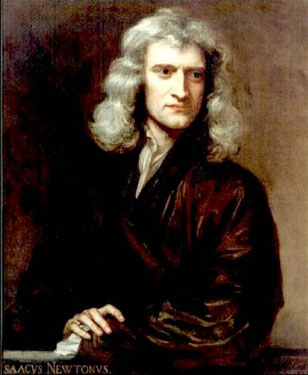
Isaac Newton
image sources:http://www.nndb.com/people/864/000024792/newton-port2-75.jpg
Newton passed a beam of sunlight through a prism. When the light came out of the prism is was not white but was of seven different colours with arrangement of Red, Orange, Yellow, Green, Blue, Indigo and Violet. The spreading into rays was called dispersion by Newton and he called the different coloured rays the spectrum.He learnt that when the light rays were passed again through a prism the rays turned back into white light. If only one ray was passed through the prism it would come out the same colour as it went in. Newton concluded that white light was made up of seven different coloured rays.
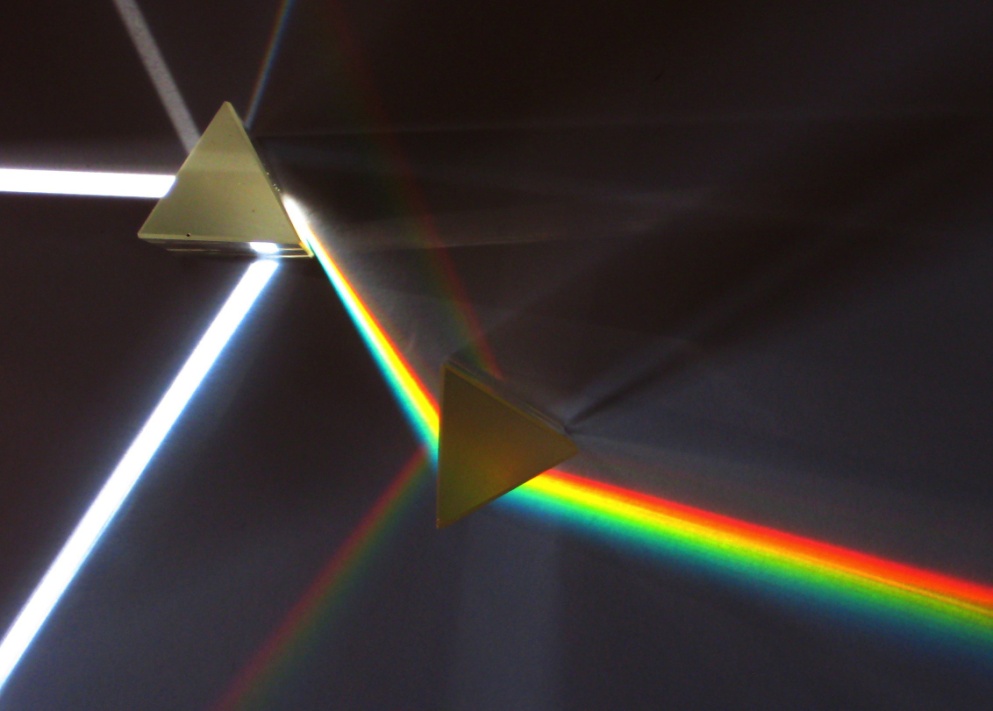
Light of dispersion
image sources:http://southerncrossreview.org/74/tao-colors-2_html_m3cc71c8.jpg
Red dye was more valuable than gold to the Aztecs, who created the colour by crushing female cochineal beetle.Yellow was produced form high concentration of cow urine with mud and sepia from the dried ink sac of squid. the colour "Red Lead" was discovered by accident around 2500 CE. Also, the first washable paint was produced in 1870s and it was named "Charlton White"

Charlton White
image sources:http://i01.i.aliimg.com/photo/v0/1535682139/Lithopone_CAS_1345_05_7_factory_with.jpg_220x220.jpg
Colour Properties
Colour wheels
Colour wheels show the relationship between colour
 Primary colour Primary colours are colour that are pure and cannot be mixed by different colours that is RED, BLUE and YELLOW. It is also the three main colours of the colour wheels.  Secondary colour Secondary colour are colours that mixed with two primary colour forming GREEN, PURPLE and ORANGE.  Tertiary colour Tertiary colour or quaternary colour is a colour mixed with one primary colour and secondary colour such as YELLOW-ORANGE, ORANGE-RED, RED-PURPLE, PURPLE-BLUE, BLUE-GREEN and GREEN-YELLOW. 
Colour Harmonious
Monochromatic colours are all the colours of a single hue. Monochromatic colours are derived from a single base hue and extend using its shades, tones and tints. Monochromatic colours use variation of lightness and saturation of one colour. For short,it was modified by the addition of black, gray and white. As a result, the energy that bring out is more subtle and peaceful due to a lack of contrast of hue. Monochromatic colours look clean and elegant, most suitable to produce soothing effect.
Complementary
Complementary colours are colour which are direct opposite of each other, its have strong attraction others attentions. The high contrast of it creates a vibrant look especially used at full saturation. Usually use in small portion and not suitable for text

Split-complementary
Split complementary colours are colours that use the two colours adjacent to its complement. It has the same strong contrast as complementary colours, but has lesser tension. It is easy to use, because it is difficult to mess up.

Analogous
Analogous colours use colours next to each other base on colour wheels. They usually are a good match to create serene and comfortable designs, but be cautions of your contrast while choosing colours. It is commonly used for showing tone of one object.

Triad
Triadic colours use colours that are evenly spaced around the colour wheels. It is tend to be quite vibrant,even when using pale or unsaturated versions of hues. To use it successful, the colours should be well balanced.

Tetrad
Tetradic or rectangle colours use four colours arranged into two complementary pairs on colour wheels. It is sometimes form a square by it's pairring. Tetrad work best when has one dominant colour, at the same time, one should pay more attention to the balance of cold and warm colours.

Example of colour harmonious in our daily life

Example 1

Example 2
Monochromatic and Achromatic colours
 Achromatic colours often name gray-scale. Black and white colours are pure colours of achromatic colours, but grey is obtained by mixing both black and white. Generally, black use to decrease brightness, in the other hand, white increase brightness . It is easy to focus on due to the tones of it, sometimes it will also shows the whereabout of light sources. Low poly 
From sketching

painting

Finish painting the big parts

More detail

Final
Colour temperature

Colour temperature wheels
Colour temperature character

painting

painting

Warm colours character

Cold colours character
Colour psychology
What is colour psychology
Colour psychology is the study of hues as a determinant of a human behavior. Colours can also work as placebos by having the colour of pills be certain colours to influence how a person feels after taking them. Example, red or orange pills are usually used as stimulants.Color psychology is also widely used in marketing and branding. Many marketers see colour as an important part of marketing because colour can be used to influence consumers' emotions and perceptions of goods and services. Companies also use colour while deciding on brand logos. These logos seem to attract more customers when the color of the brand logo matches the personality of the goods or services, such as the color pink being heavily used on Victoria's Secret branding. However, colors are not only important for logos and products, but also for window displays in stores. Research shows that warm colours tended to attract spontaneous purchasers, despite cooler colors being more favorable.

For marketing
image sources:https://s3.amazonaws.com/m.helpscout.net/blog/2013/jul/color-emotion.jpg

As web
image sources:http://blog.thinkcreativegroup.com/http://blog.thinkcreativegroup.com/wp-content/uploads/2010/09/colourlovers_spectrum.png

For branding
image sources:http://mwpdigitalmedia.com/blog/wp-content/uploads/2015/02/2.jpg
Light moves in waves of varying lengths and as each colour has a different wavelength, we sense them all individually. Colour therapists believe that different colours in the spectrum correspond with the body's inner vibrations. If your vibrations are off-kilter, therapists believe that colour can harmonise and rebalance them if treated with the right colours. Depending on your mood and physical health, the colour therapist will use specific colours that treat the afflicted parts of your body.Colour therapy is administered in several ways. In many treatments coloured lights are shone on the body or coloured silks are worn. Other practitioners use different coloured liquids in bottles or small torches with coloured beams that are pointed at the relevant acupressure points.Several ancient cultures, including the Egyptians and Chinese, practiced chromotherapy, or the use of colors to heal.

image sources:http://loveanaturalme.info/wp-content/uploads/2014/11/color-therapy.jpg
Colours hold significance for people around the world. Not only do colours influence emotion, but they also hold meaning in religion and various cultures.

list of colour symbolism and meaning
image sources:http://usercontent2.hubimg.com/6760499_f520.jpg

list of colour symbolism and meaning
image sources:http://media.creativebloq.futurecdn.net/sites/creativebloq.com/files/images/2013/08/logo-color-psychology-wheel.jpg
In chinese culture, yellow symbolized royalty and power of the throne. Red is Chinese national color that represents happiness, beauty, success and good fortune. And not the least, green for money. Red is considered the luckiest color in China, and it is widely used during festivals and important events like wedding

image sources:http://www.thechinesequest.com/wp-content/uploads/2014/07/Chinese-Color-Guide.jpg
Reference

Sketching
 |

No comments:
Post a Comment